

FPCC Arts Grants support the revitalization of cultural weaving practices
First Nations Arts in B.C. have a long and nuanced history, stretching back to time immemorial. Important cultural artforms, like weaving, are at risk with barriers to the transference of skills and knowledge, as well as access to necessary materials. FPCC’s Arts Program supports projects that work to ensure the future vitality of these arts practices that are so connected to our cultures, languages and heritage.
Weaving confidence and skill
Gitxsan artist Tiffany Smith recently enhanced her Chilkat weaving skills with support from an FPCC Individual Artists Grant. The funding gave her the opportunity to spend time with her mentor Cheyenne Morgan with whom she learned to design and complete multiple weaving projects. Tiffany now feels more confident in her abilities in this important cultural arts practice.
“This project has contributed greatly to my creative development,” Tiffany says. “I feel now like I have a solid foundation on the basic techniques used in Chilkat weaving and can weave on my own. It has also really boosted my confidence. My mentor suggested that I consider doing an art show with a local gallery.”
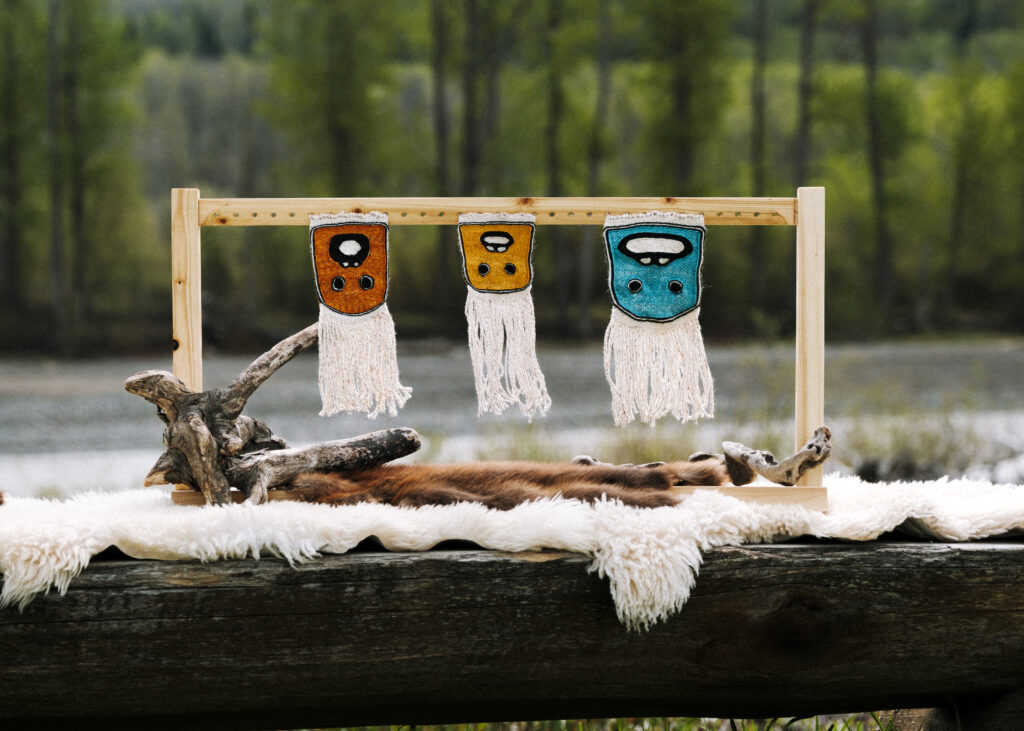
Art has always been an important part of Tiffany’s identity, something that she describes as a “sanctuary”.
“Art has given me an outlet to share what I see in my mind with the people around me,” Tiffany says. “Creating art always leaves me feeling grounded and at peace. During my childhood I was lucky to have a mother who is an artist and that gave me the opportunity to learn from her and many of her peers.”
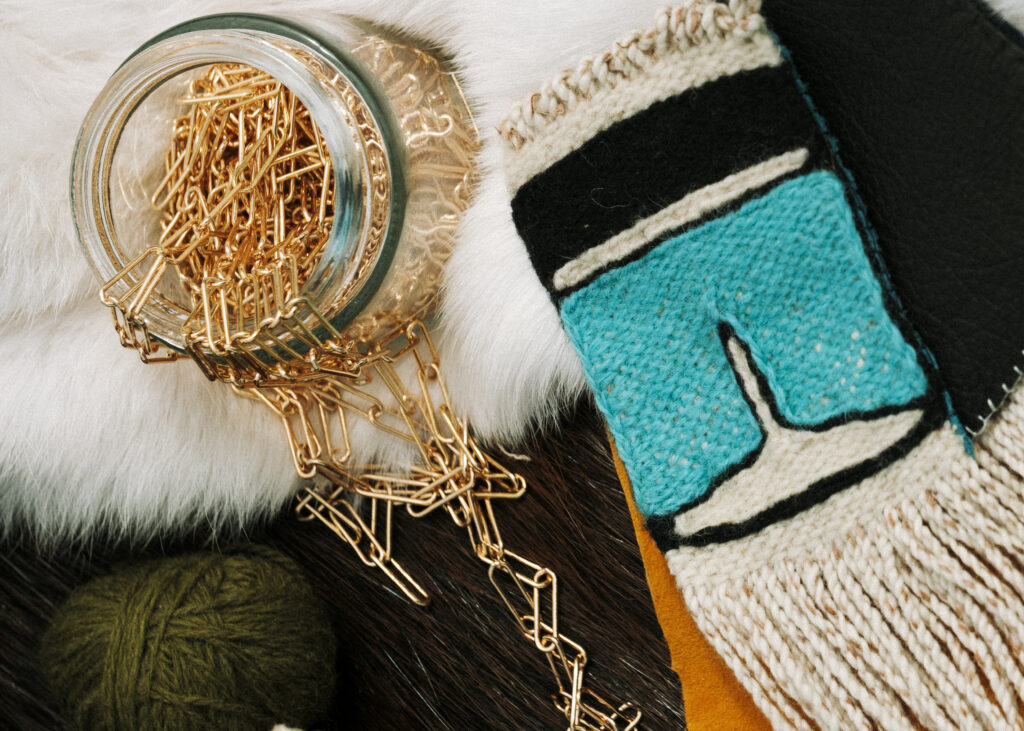
Tiffany’s long-term goal is to teach her ancestral practice to the next generation of weavers:
“I am really excited that moving forward I can teach my children and other members in my community the basic foundations of Chilkat weaving.”
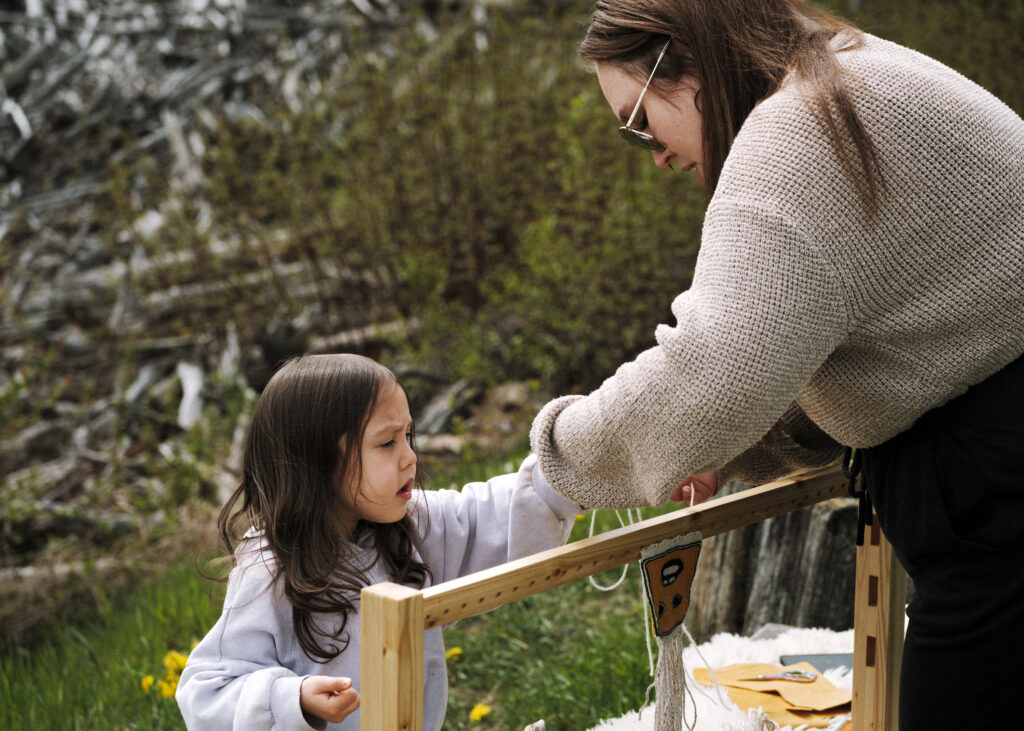
Weaving knowledge
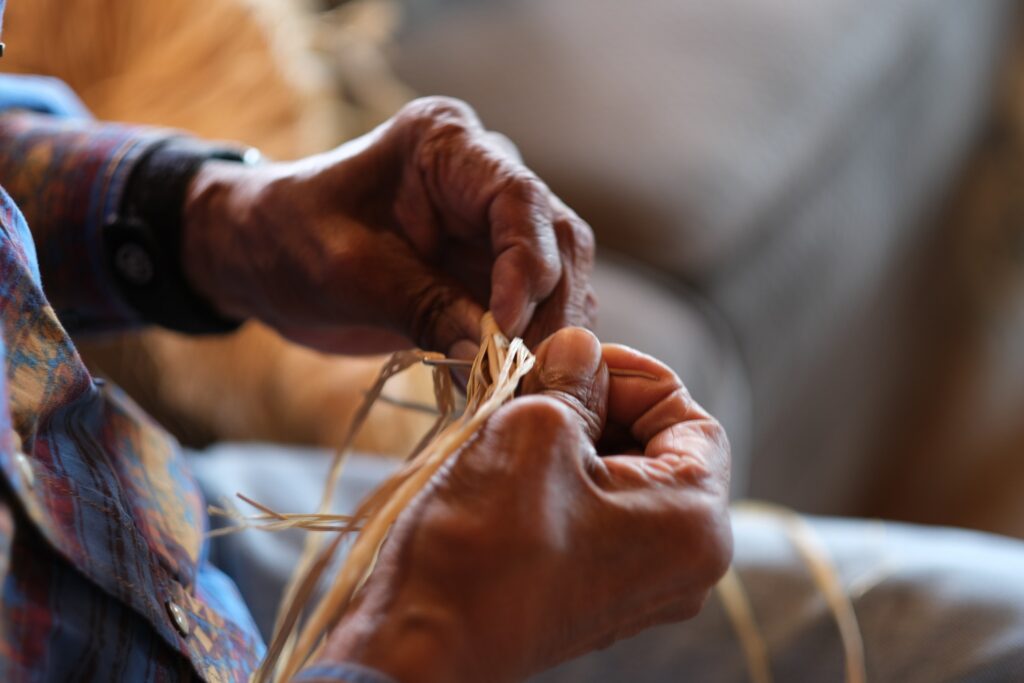
A recent FPCC Arts Infrastructure grant is supporting the revitalization of Tsilhqot’in spruce root basket weaving. The project brought together a variety of community Knowledge Keepers over multiple workshops to share what they know of about the artform that has been practiced for generations.
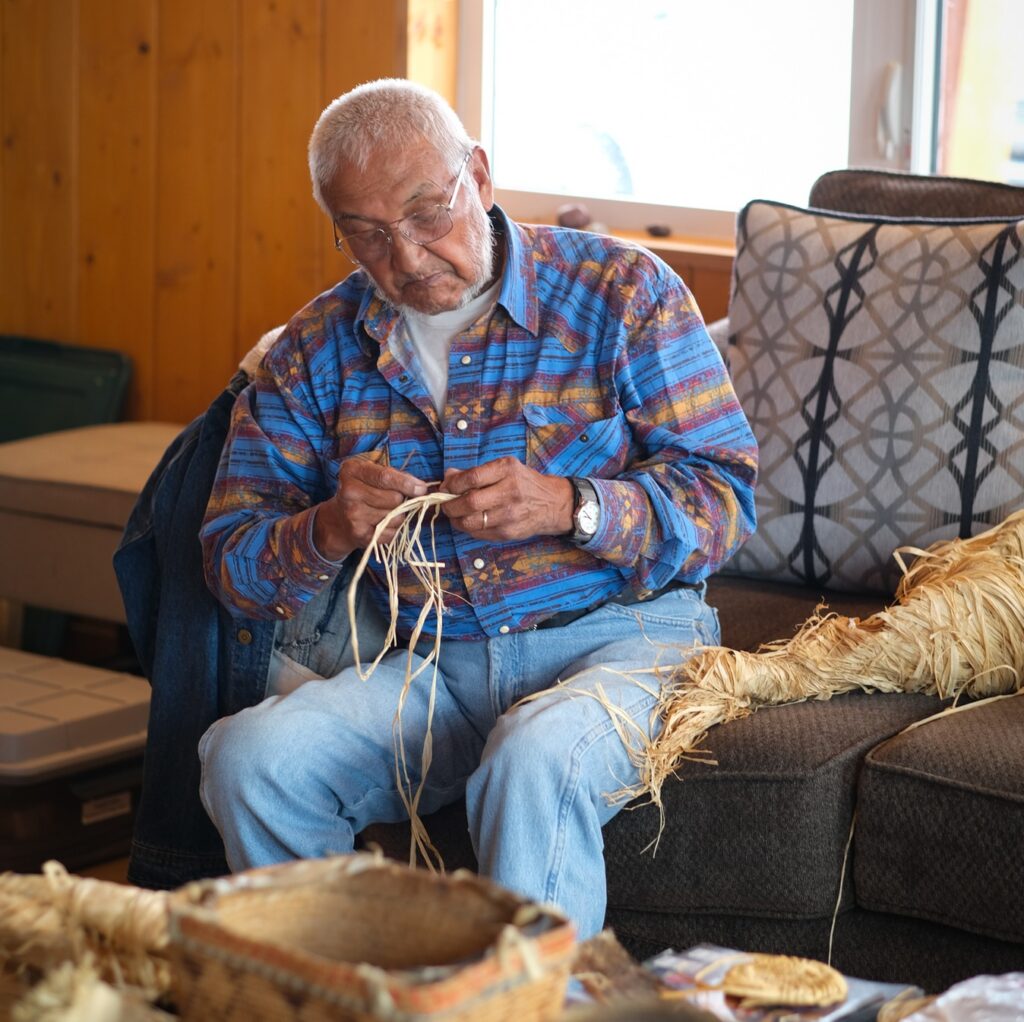
Qatŝ’ay (Tsilhqot’in traditional spruce root baskets) are rectangular pieces woven with Ts’u-ghi (spruce root) with Tl’ekw’a (Common Reed Grass) and Ch’entSay-t’uz or Nanchilh-t’uz (Waterbirch bark) imbricated on the exterior, making two full layers of woven material. The exterior layer features different patterns and animal designs that can resemble pictographs and petroglyphs found in Tsilhqot’in territory.
Learning the practice of weaving these baskets requires an intimate knowledge of the land, how to harvest and prepare the spruce root, as well as the complex weaving techniques and designs. The impacts of climate change have brought new challenges to the availability of materials for those who weave with roots.
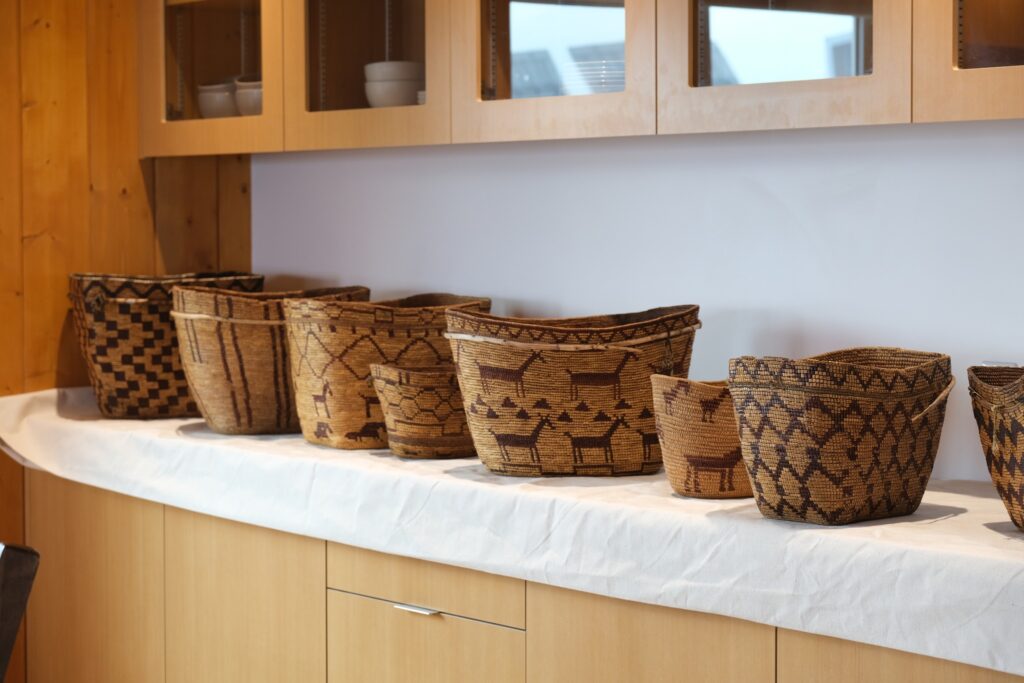
The weaving project was lead by Sech’iziqi Arts & Culture Society. The format of the workshops was collaborative, as re-creating the complex basket weaving style required drawing on many different skill sets, weaving styles and memories.
“We are so thankful [for] the Tsilhqot’in spruce root weavers who have so much knowledge around circular spruce root weaving and much memory of some of the older styles of weaving. Sechanalyagh to Gloria Charleyboy, Linda Smith, Lennie Billy, Irene Toby and Leslie Hunlin for their continued sharing and leading in this regeneration process. And of course, to all their teachers who shared with them through their lives.” – Helen Haig-Brown, Sech’iziqi Arts & Culture Society.
Weaving language
Language, arts and cultural practices are often deeply intertwined and incorporating language learning into an arts practice can help to share knowledge. Coast Salish artist Ts’iyuhaat Agnes Violet Sharon Seymour received an Individual Artist grant to improve both her cedar weaving skills and her knowledge of the Hul’q’umi’num’ language. Ts’iyuhaat first learned to weave when she joined a group for first time mothers. It was there she learned how to weave a wool blanket and a cedar hat for her baby.
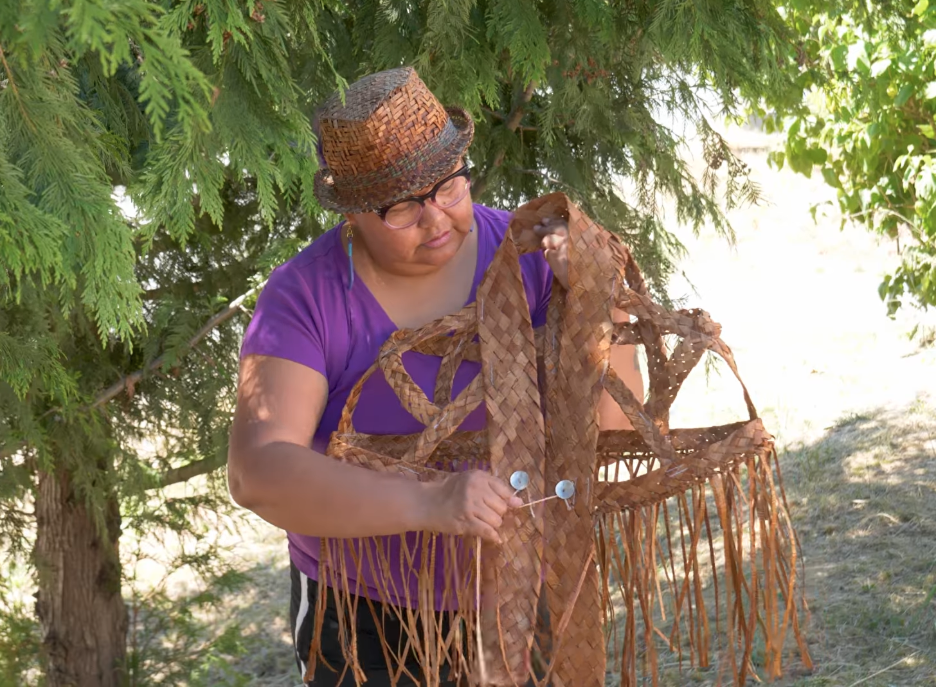
“Working with cedar is very healing to me. It helps me feel connected to my family, to my Elders, and to my homeland,” Ts’iyuhaat says. “In our culture, we use cedar for everything. It is the lifeblood of our people. It has sustained us for millennia—giving us canoes, homes, clothing, and medicine. It’s not just a tree; it’s a relative.”
During the project, Ts’iyuhaat taught cedar weaving workshops organized by the Hul’q’umi’num’ Language & Culture Society. She incorporated Hul’q’umi’num’ words that she had learned into those lessons.
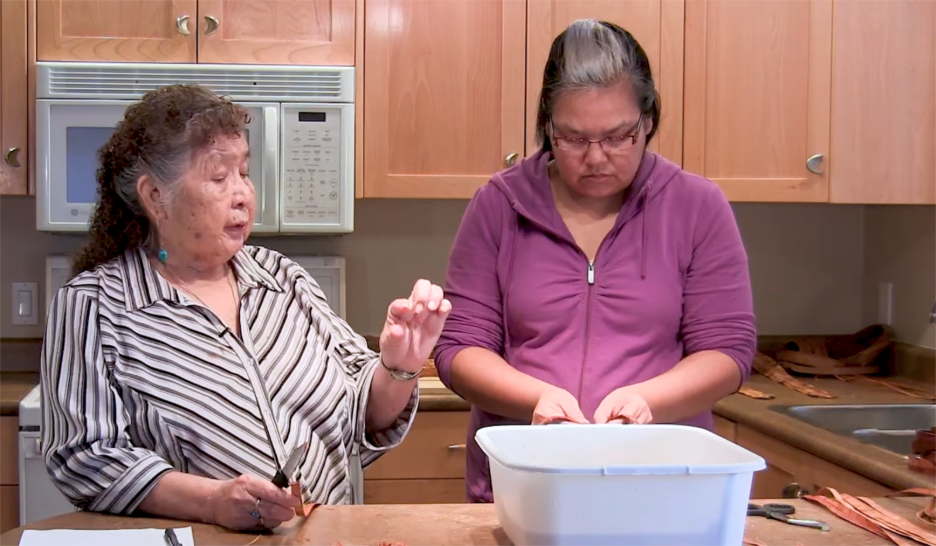
“I became a more confident artist and Hul’q’umi’num’ speaker because of this project,” Ts’iyuhaat says. “It felt good to share these teachings with new learners, just as my mentors shared them with me. I didn’t get here alone. I was mentored by Maria, as well as by Grandma Ruby, Grandma Delores, and Uncle Merle. Now, I get to pass their teachings on. That is the greatest feeling.”
When Ts’iyuhaat was asked to share her creations through a public theatre performance, she jumped at the opportunity to showcase her work through a live performance. Several of her pieces were used in the Hul’q’umi’num’ Language & Culture Society Theatre Group’s performance of the story of tth’asiyetun. The performance took place at the Indigenous Theatre Festival hosted by the University of Victoria in September 2025.
“For our culture to survive, it can’t be a museum exhibit. It has to be lived,” Ts’iyuhaat says. “Through my art I strive to create pieces that spark a connection for our youth, guiding them back to our traditions. This project has elevated my work, but its real success will be inspiring a new generation to weave their future from the threads of our past.”
You can learn more about Ts’iyuhaat’s artistic journey by watching the video below. Both images above are stills from the video.
Whether you are a weaver, painter, singer or any form of arts practitioner, FPCC is supporting B.C. First Nations artists to grow in their area of practice and provide opportunities to share their knowledge and skills. If you are interested in working with a mentor, increasing your skill, sharing or documenting your work, performing and more, please check out the FPCC Arts Program page linked below to see how FPCC can support you on your journey.
Apply Now to FPCC’s Arts Program
Our Arts program is now open for applications! The FPCC Arts Program supports B.C. First Nations artists, communities and organizations working in both ancestral and contemporary arts by delivering grants, workshops and programs to positively impact creative sovereignty in their respective activities, knowledge transfer, training and professional development.
Visit the Arts Program page to view our current funding opportunities, eligibility and funding guidelines, and to watch the information sessions.
The deadline to apply is March 5, 2026, at 4:30 p.m. PT.
We are here to provide support
If you have questions or need any assistance completing your application or using the grant portal, please contact the program staff listed at the bottom of each of our program page.
Share Your Story!
Do you have a story about the work your community is doing to revitalize First Nations languages, heritage and arts in B.C.? We want to hear from you! Please send your story to info@fpcc.ca and check back as we post more stories about the good work being done across the province.
Connect with Us
To receive FPCC news and funding announcements, please sign up for our email list here.
To view all current FPCC funding opportunities please visit our Grants page.
Follow FPCC on social media for updates: Facebook | Twitter (X)| LinkedIn | Bluesky | YouTube